
 English
 Türkçe
 Русский
 Español
 Français
 Deutsch
 한국어
한국어
 中文
中文
 Italiano
 日本語
日本語
 Português
2-Day Private Ephesus & Pamukkale Tour from Istanbul: Flights, Hotel, and Ancient Wonders

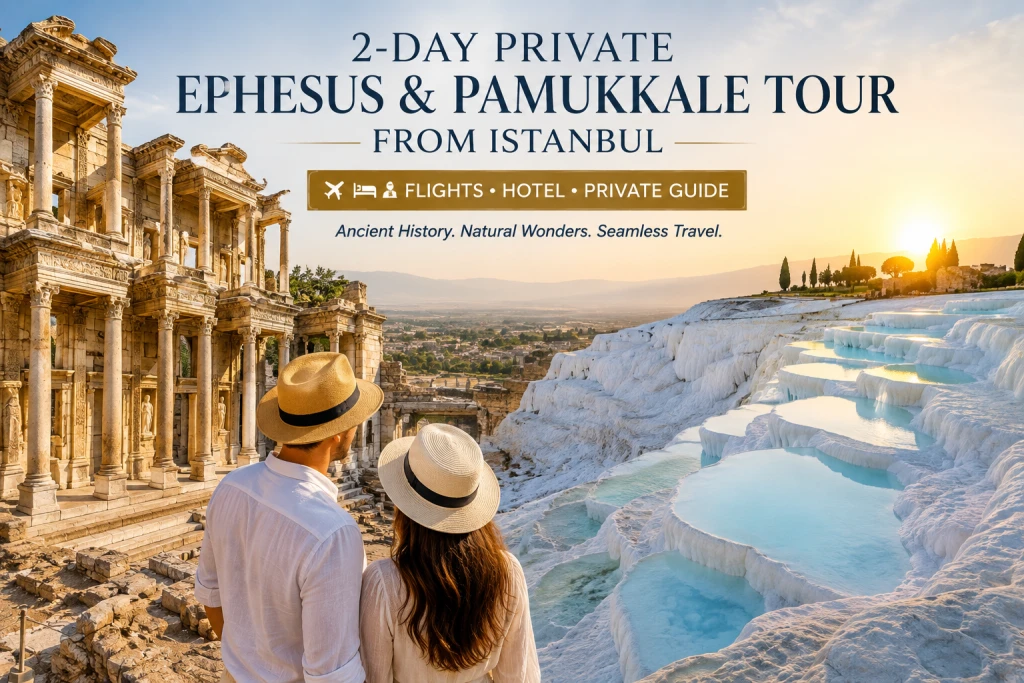
Some of Turkey’s most unforgettable places are far beyond Istanbul — but that does not mean they have to be difficult to reach.
With a carefully planned 2-day private Ephesus and Pamukkale tour from Istanbul, you can leave the city behind, fly to Turkey’s Aegean region, walk through one of the ancient world’s greatest cities, stay overnight in comfort, and explore Pamukkale’s white terraces and the ruins of Hierapolis the following day.
This is not a rushed attempt to collect two famous destinations.
It is a private journey designed to connect history, natural beauty, and seamless travel in one well-organized experience.
Domestic flights, airport transfers, hotel arrangements, private transportation, and professional guiding help remove the difficult parts of planning. Instead of comparing flight times, arranging separate transfers, and trying to understand how to connect Ephesus with Pamukkale, you can focus on the places themselves.
In two days, you move from ancient marble streets to mineral-white terraces.
The contrast is extraordinary.
Why Combine Ephesus and Pamukkale in One Private Tour?
Ephesus and Pamukkale offer two completely different sides of Turkey.
Ephesus is defined by human achievement.
Its marble roads, monumental buildings, theaters, temples, and public spaces reveal the scale and sophistication of life in the ancient world. Walking through the city gives you a sense of how people lived, gathered, traded, worshipped, and entertained themselves centuries ago.
Pamukkale is defined by nature.
Its white travertine terraces were formed by mineral-rich thermal waters flowing across the hillside. Above them stands Hierapolis, an ancient city closely connected to the region’s healing springs.
One destination gives you architecture and archaeology.
The other gives you natural beauty and thermal history.
Together, they create one of the strongest short travel routes in Turkey.
Why a 2-Day Tour Works Better Than Trying to See Everything in One Day
Technically, travelers may find itineraries promising Ephesus and Pamukkale in a single day.
But the distance between the sites, airport timing, road travel, walking, and the scale of both destinations can make a one-day program feel exhausting.
A two-day itinerary protects the quality of the experience.
You can dedicate the first day to Ephesus instead of checking the time constantly. You can walk through the ancient city with a guide, understand its major monuments, enjoy the surroundings, and continue to your hotel without facing an immediate return flight.
The second day can then focus on Pamukkale and Hierapolis.
This creates a much better rhythm.
You are not racing between ruins and terraces.
You are giving each destination enough space to leave an impression.
Day 1: Fly from Istanbul to the Aegean Region
Your journey begins with an early transfer from your Istanbul hotel to the airport.
After a short domestic flight, you arrive in Turkey’s Aegean region, where your private travel arrangements continue.
The change from Istanbul is immediate.
The energy of the city gives way to open landscapes, olive-growing areas, smaller towns, and the warmer atmosphere of western Turkey.
Your driver and guide coordinate the arrival so that you can continue toward Ephesus without trying to navigate local transportation or complicated connections.
This is one of the main advantages of choosing a complete private package.
The journey does not begin when you reach the ancient city.
It begins when you leave your hotel in Istanbul.
Ephesus: Walk Through One of Turkey’s Greatest Ancient Cities
Ephesus is not a place that should be reduced to one famous photograph.
The Library of Celsus may be its most recognizable monument, but the ancient city is much larger and more complex.
As you enter Ephesus, you begin walking through a world of marble streets, public buildings, fountains, temples, gathering spaces, and residential areas.
With a private guide, the ruins become a living story.
You learn how the city developed, why its location mattered, how public life was organized, and what daily existence may have felt like during its most important periods.
Instead of simply seeing old stones, you begin to understand the people behind them.
The Library of Celsus
The Library of Celsus is one of the most iconic ancient structures in Turkey.
Its restored façade is elegant, detailed, and immediately recognizable. But its importance is greater than its appearance.
Your guide can explain why the building was created, how it functioned, and what it represented within the city.
Standing in front of the library is one of the defining moments of an Ephesus visit.
The columns, statues, carved details, and marble setting make it easy to imagine the scale and confidence of the ancient city.
It is also one of the best photography locations along the route.
On a private tour, you have more freedom to pause, ask questions, and appreciate the setting without being pushed forward by a large group.
The Great Theatre
The Great Theatre reveals another side of Ephesus.
Built into the hillside, it once welcomed thousands of spectators and played an important role in entertainment, public life, and civic gatherings.
Standing inside the theater helps you understand the size of the ancient population and the importance of shared public spaces.
It is not difficult to imagine the sound, movement, and energy that once filled the structure.
From the upper levels, the view also helps place Ephesus within its wider landscape.
The city begins to feel connected rather than simply a collection of separate ruins.
Marble Streets and Everyday Ancient Life
Some of the most meaningful moments in Ephesus happen between the major monuments.
As you walk along its ancient streets, you encounter the remains of fountains, temples, baths, public spaces, and decorative details that reveal how the city functioned.
These smaller elements help the ancient world feel more human.
You begin to think about ordinary routines:
Where people met.
How they moved through the city.
Where they shopped.
How social life was organized.
How status and wealth appeared in architecture.
A knowledgeable private guide can shape the explanation around your interests, whether you are drawn to archaeology, Roman engineering, architecture, religion, or everyday life.
That flexibility makes Ephesus especially rewarding on a private tour.
The Temple of Artemis
The Temple of Artemis adds another important layer to the story of the region.
Although only limited remains can be seen today, the site was once associated with one of the ancient world’s most celebrated monumental structures.
The visit is valuable because it helps connect Ephesus to a wider religious and historical landscape.
Your guide can explain the temple’s significance, the role of Artemis, and why the area attracted travelers and pilgrims in antiquity.
It is a reminder that even when little remains above ground, the meaning of a place can still be enormous.
A Private Guide Changes the Experience
Ephesus is visually impressive even without explanation.
But understanding it requires context.
A private guide can connect the monuments, explain the chronology, answer questions, and adjust the level of detail to your interests.
History lovers may want to go deeper into political and religious changes.
Architecture enthusiasts may focus on engineering, planning, and decoration.
Families may prefer shorter explanations and a more flexible walking pace.
Photographers may want extra time at the Library of Celsus or the Great Theatre.
A private tour allows the ancient city to become your experience rather than a fixed presentation delivered to a large group.
Overnight Stay: Time to Rest Between Two Major Destinations
After the Ephesus program, you continue to your hotel for an overnight stay.
This is not simply a logistical break.
It is what makes the two-day route comfortable.
You have time to rest after the flight, walking, and sightseeing. You can enjoy the evening without worrying about an immediate airport transfer or another long day of travel.
Depending on the confirmed program and hotel location, the overnight stay may be arranged in the most practical area for the following day’s Pamukkale visit.
The exact hotel and flight schedule may vary according to availability and travel dates, but the purpose remains the same: to create a smooth connection between Ephesus and Pamukkale.
A well-planned night makes the second day feel fresh instead of exhausting.
Day 2: Pamukkale and the Ancient City of Hierapolis
After breakfast, the journey continues toward Pamukkale.
The first view of the white hillside is striking.
Pamukkale means “Cotton Castle” in Turkish, and the name reflects the appearance of its bright travertine formations. Mineral-rich thermal water has flowed over the hillside for centuries, creating white terraces and shallow pools.
The landscape looks almost snowy from a distance.
But the experience is warm, mineral, and completely unique.
Pamukkale is not only one of Turkey’s most recognizable natural attractions. It is also closely connected to the ancient city of Hierapolis, which developed above the thermal springs.
This combination of nature and history is what makes the destination so powerful.
Walking on Pamukkale’s White Travertines
Visitors can walk barefoot in designated areas of the travertines.
The surface, flowing water, and open views create a completely different experience from the previous day’s marble streets.
Ephesus is structured, architectural, and monumental.
Pamukkale feels open, bright, and natural.
As you walk along the permitted sections, you can see how the water moves across the white formations and look out over the landscape below.
Conditions can vary according to water management, weather, and conservation requirements, so not every section will always look exactly like photographs seen online.
A guide helps set realistic expectations and shows you how the travertines connect with the larger archaeological site.
Hierapolis: The Ancient City Above the Terraces
Many visitors arrive thinking Pamukkale is only about the white pools.
Hierapolis changes that understanding.
The ancient city sits above the travertines and was closely associated with thermal waters, healing, and regional life.
Its remains include streets, public buildings, a theater, sacred spaces, and an extensive necropolis.
Exploring Hierapolis gives the day historical depth.
You are not simply visiting a natural formation. You are seeing how ancient communities built a city around a landscape they considered valuable for health, spirituality, and daily life.
The relationship between the city and the thermal springs is one of the most interesting parts of the visit.
The Ancient Theatre of Hierapolis
The theater is one of the most impressive structures in Hierapolis.
Its scale, hillside position, and architectural details demonstrate the importance of performance and public gathering in the ancient city.
After walking through the wider archaeological site, the theater provides a strong visual highlight.
It also offers a different perspective from the Great Theatre of Ephesus.
Seeing both within the same private journey allows travelers to compare how two important ancient cities developed and used monumental public spaces.
The Antique Pool Experience
Pamukkale’s Antique Pool, often called Cleopatra’s Pool, offers an optional thermal experience.
The pool is known for its warm water and ancient architectural fragments beneath the surface.
Swimming is generally available for an additional fee and depends on current operating conditions.
Some travelers choose to swim, while others prefer to spend more time exploring Hierapolis and the travertines.
A private itinerary gives you greater flexibility to make that choice.
The day should reflect your interests, not a rigid group timetable.
Two Destinations, Two Completely Different Experiences
The greatest strength of this tour is contrast.
In Ephesus, you walk through carefully organized ancient streets and stand before monumental architecture.
In Pamukkale, you move through a natural thermal landscape and explore a city built above mineral springs.
Ephesus feels urban and sophisticated.
Pamukkale feels bright and elemental.
One tells the story of a powerful ancient city.
The other reveals the relationship between people, healing waters, and the natural landscape.
Experiencing them together gives you a much broader understanding of Turkey.
Who Is This 2-Day Private Tour Perfect For?
This private Ephesus and Pamukkale tour is especially suitable for:
Travelers staying in Istanbul who want to discover western Turkey without organizing multiple bookings.
Couples looking for a cultural and scenic overnight escape.
Families who need a flexible pace and private transportation.
Small groups who prefer personalized guiding over a shared coach tour.
History lovers who want to explore Ephesus and Hierapolis with context.
Travelers with limited vacation time who still want to see more than Istanbul and Cappadocia.
Guests who value smooth airport transfers, hotel coordination, and complete travel planning.
The route is ideal for anyone who wants two major Turkey experiences without turning the journey into a stressful logistical exercise.
Why Choose a Private Tour Instead of a Shared Package?
A shared package may visit many of the same locations.
But it cannot provide the same rhythm.
With a private tour, you do not spend the morning collecting passengers from multiple hotels. You are not required to follow the walking speed of a large group. You can ask questions, take breaks, and spend more time at the sites that interest you.
This matters in both Ephesus and Pamukkale.
The ancient sites involve walking, uneven ground, open areas, and changing weather conditions. Different travelers have different comfort levels and interests.
A private vehicle also makes the transfers more comfortable.
After a full day at Ephesus, the ability to continue directly to your hotel is valuable. After Pamukkale, a coordinated airport transfer helps protect your return flight timing.
Private travel does not only feel more exclusive.
It makes a short itinerary work more intelligently.
Flights and Hotel: Why a Complete Package Makes Sense
Planning this route independently requires several separate decisions:
Which Istanbul airport should you use?
Which flight connects best with the first day’s program?
How will you travel from the airport to Ephesus?
Where should you stay overnight?
How will you continue to Pamukkale?
Which airport should you use for the return journey?
How much time should you leave between the tour and the flight?
A complete package brings these pieces together.
Flights, hotel arrangements, transfers, guiding, and sightseeing are coordinated as part of one travel plan.
Exact flight times, baggage allowances, hotel options, and detailed inclusions may vary by departure date and selected package, so these should always be confirmed before booking.
But the main benefit remains clear:
You are buying a complete journey rather than trying to assemble disconnected reservations.
Practical Tips for the Tour
Wear comfortable walking shoes. Ephesus, Hierapolis, and Pamukkale involve uneven surfaces and extended walking.
Bring sun protection, especially during late spring and summer. A hat, sunglasses, sunscreen, and water are useful.
Pack light for the overnight stay. A small bag makes domestic flight and hotel logistics easier.
Bring swimwear if you may want to use the Antique Pool.
Expect to remove your shoes in designated travertine areas.
Share any mobility concerns before booking so the route can be planned realistically.
Confirm the final flight schedule, hotel, baggage rules, entrance fees, and meal inclusions for your selected travel date.
Good preparation helps the two-day itinerary feel comfortable from beginning to end.
Why Travel with Bien Cappadocia Travel?
Bien Cappadocia Travel is a licensed local Turkish travel agency specializing in private tours, tailor-made itineraries, and premium travel planning across Turkey.
For a multi-destination tour, coordination matters as much as sightseeing.
Flights must connect with transfers.
Transfers must connect with the guide.
The hotel must support the route.
The second day must leave enough time for Pamukkale and the return journey.
Our goal is to organize those moving parts into one smooth experience.
You receive the freedom of private travel without the stress of planning everything alone.
Whether you are adding Ephesus and Pamukkale to an Istanbul vacation, combining them with Cappadocia, or building a longer private Turkey itinerary, the journey can be adjusted around your dates, interests, and pace.
Final Thoughts: From Ancient Marble to Thermal White Terraces
A 2-day private Ephesus and Pamukkale tour from Istanbul with flights and hotel is one of the most efficient ways to experience western Turkey without sacrificing comfort or depth.
On the first day, you walk through Ephesus and discover a city of marble streets, monumental buildings, theaters, temples, and ancient stories.
After an overnight stay, the second day brings a completely different landscape: Pamukkale’s white travertines, thermal waters, and the ruins of Hierapolis.
The journey is short, but the contrast makes it feel substantial.
You experience archaeology and nature.
Ancient urban life and thermal landscapes.
Human achievement and geological beauty.
With Bien Cappadocia Travel, the flights, transfers, hotel arrangements, guiding, and travel flow are brought together so you can focus on what matters most:
Experiencing two of Turkey’s greatest wonders properly.
Plan Your Private Ephesus and Pamukkale Journey
Your travel dates, flight availability, hotel preferences, group size, and interests can all shape the final program.
Tell us when you are traveling, how many guests will join, and whether you are beginning and ending in Istanbul.
Our team will help arrange a private Ephesus and Pamukkale itinerary designed around your journey.